

Travel | Updated October 2026
Ask most Americans what they think of China and the answer comes fast. In Pew Research Center’s spring 2026 survey, 27 percent of Americans viewed China favorably and 71 percent unfavorably. That favorable share has nearly doubledsince 2023, but the picture is still lopsided.
Most of those opinions are shaped from a distance, through headlines, political rhetoric, and social media rather than a plane ticket. Governments and media on both sides of the Pacific push their own narratives, and a country of roughly 1.4 billion people does not fit neatly inside any of them.
This article is not asking you to love China. China is not perfect, and no country is. It is asking you to consider going, and to form your own opinion with your own eyes.
A very long story, told briefly
China’s history is written into some of the most remarkable places on Earth. In 1974, farmers digging a well near Xi’anstruck the first of an estimated 8,000 life-size terracotta soldiers buried to guard Qin Shi Huang, the emperor who unified China and died in 210 BC. In Beijing, the Forbidden City was built between 1406 and 1420 and still holds 980 surviving buildings. The Great Wall was begun in the third century BC and extended by dynasties for nearly two thousand years, with the best-known stretches built under the Ming.
The scale of it is hard to overstate. China now has 61 UNESCO World Heritage Sites, second only to Italy, after the Jingdezhen porcelain sites were added in July 2026.
Three reasons to go
1. Getting around is part of the adventure
China’s high-speed rail network grew past 50,000 kilometers in 2025, reaching 50,400 kilometers by year’s end, according to the national railway operator. Its transport minister said in mid-2025 that the network already accounted for over 70 percent of the world’s high-speed track and reached 97 percent of cities with more than 500,000 people.
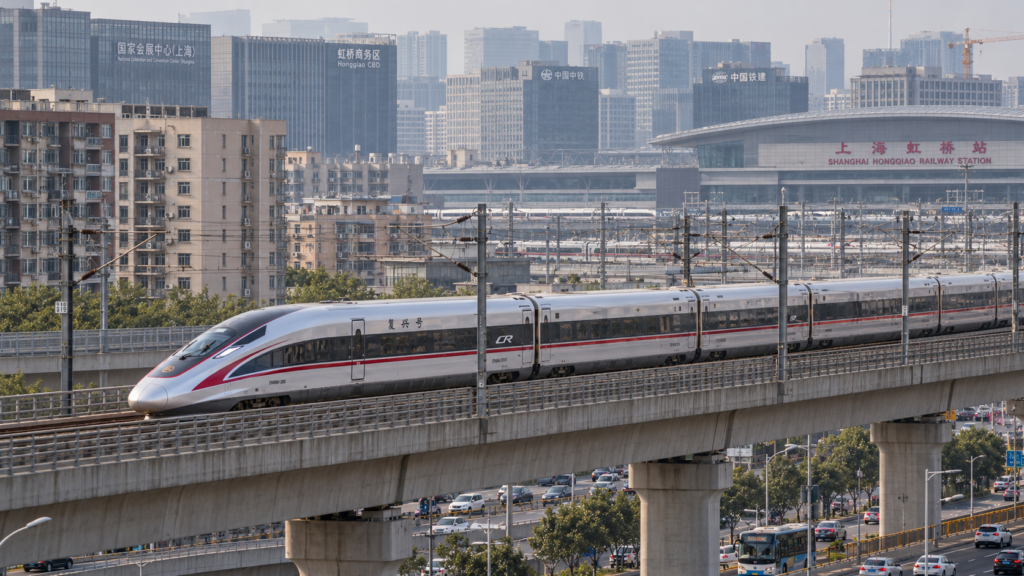
For a visitor, that turns into a practical advantage. On the flagship Beijing to Shanghai line, a 1,318 kilometer run, the fastest trains take as little as 4 hours and 18 minutes, and the Fuxing trainsets on that route are scheduled at 350 kilometers per hour. Stations sit in city centers, and the trip often rivals flying once airport transfers and security are counted. Inside the cities, urban transit is just as ambitious. Shanghai’s metro alone spans more than 800 kilometers.
The system has its critics. A 2011 crash near Wenzhou killed 40 people and led China to cut speed limits for several years, and some economists question whether the most expensive lines will ever turn a profit. Even so, the scale and reliability of the network is something an American traveler will not find at home.
2. You can see where everyday technology is heading
China runs largely on mobile payments. The State Department notes that most people pay with apps like WeChat and Alipay, and both now let foreign visitors link Visa and Mastercard cards, which removed one of the biggest headaches for tourists. The same State Department page cautions that cash and cards are accepted less widely than in the US and that the apps may share data with Chinese authorities.
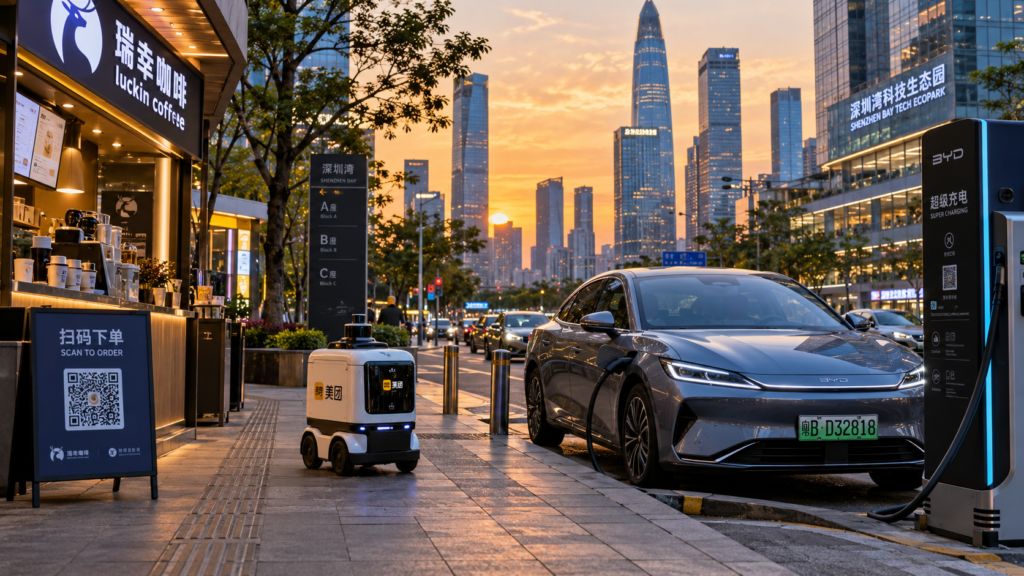
The street scene is changing too. China accounted for roughly 60 percent of global EV sales in 2025, and electric vehicles made up 55 percent of its own new car sales. BYD overtook Tesla as the world’s top seller of battery electric cars last year. You do not need to be a tech enthusiast to notice it. You will see it in the traffic, the charging stations, and the way people pay for a bowl of noodles.
3. It is safer and more varied than its reputation suggests
The State Department’s own guidance says most visitors find China to be a safe destination and that violent crime is uncommon. It also describes women travelers as generally experiencing a high level of safety. The same guidance does note that stabbings have targeted foreigners in the past, so common sense still applies, as it would anywhere.
Beyond safety, the variety is the real draw. Xi’an, Beijing, and Shanghai feel like three different countries, and the landscapes and regional cuisines change again as you travel south and west. A first-time visitor can fill two weeks without repeating a theme. And because China is so rarely seen firsthand by Americans, even a short trip can change how you read the news about it, whichever direction that change goes.
The fine print: what Americans need to know before booking
The biggest hurdle is paperwork. Americans are not on the list of countries that can enter mainland China visa-free for 30 days. That list covers 50 countries, and in February 2026 China extended it to the UK and Canada, leaving the US as the only Five Eyes member excluded. The State Department says most Americans must obtain a visa before arriving, and that most can apply for a 10-year multiple-entry tourist visa. Third-party guides report the fee at a reduced $140 through the end of 2026, but confirm the current price with the Chinese embassy before you apply.
There are limited exceptions. Travelers connecting through China to a third country can use a 240-hour (10-day) visa-free transit at designated ports. Americans can also stay up to 30 days in Hainan without a visa for tourism, as long as they arrive by direct international flight or via Hong Kong or Macau. Tibet requires a separate permit on top of the visa.
A few other entry rules catch people off guard. Your passport must be valid for at least six months beyond your arrival date and have at least two blank pages. You must register your address with local police within 24 hours of arrival, which hotels usually handle for guests, and you are expected to carry your passport and visa at all times.
The larger caution is legal. The State Department’s advisory, issued September 4, 2026, rates mainland China at Level 2, exercise increased caution, citing arbitrary enforcement of local laws, exit bans issued without a transparent legal process, and the risk of unjust detention. It says some groups face more scrutiny, including Americans of Chinese heritage, people involved in business disputes, and those with current or past ties to the US government. It also recommends avoiding demonstrations and keeping a low profile on political topics. For a typical tourist the practical risk is low, but these are real considerations and every traveler should read the advisory before booking. Level 2 is the second lowest rating on the State Department’s four-point scale, well below the “reconsider travel” level it applies to Macau.
Go see for yourself
None of this is a reason to stay home. It is a reason to prepare. China has a visa process, a political system that most Americans disagree with, and rules that are enforced differently than they are in the US. It also has one of the world’s oldest continuous civilizations, a rail network that has no real equivalent, and cities that show what a fast-changing economy looks like up close.
If you go, you may come back more critical of some things and more impressed by others. Either way, you will have an opinion that belongs to you, built on what you saw, rather than one handed to you by a headline. That is the best argument for buying the ticket.
