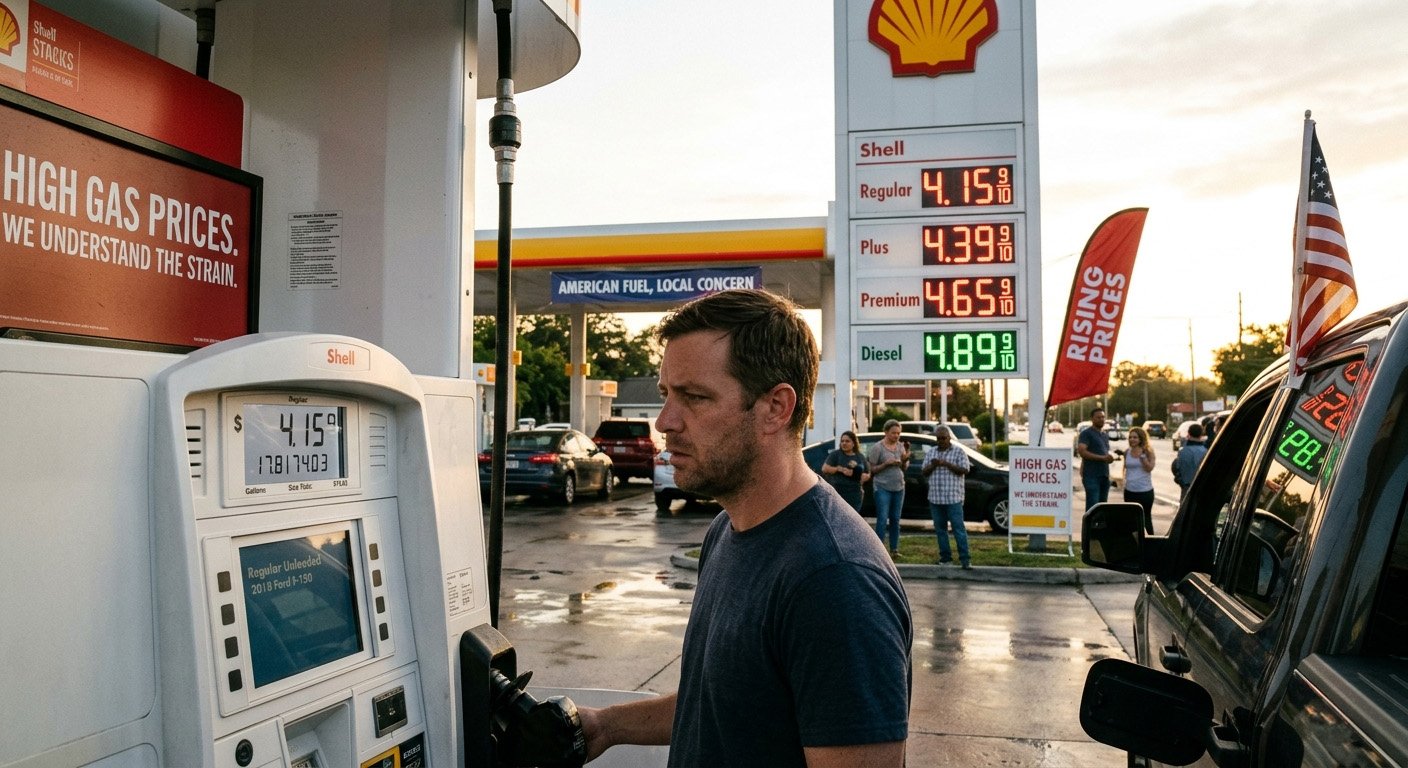
$4 a Gallon and Climbing: How the Gas Price Surge Is Hitting American Families
Americans who were just starting to breathe easier at the pump are now facing the sharpest price spike in years — and this time, the cause is a war.
Gas prices hit a nationwide average of $4.018 per gallon at the end of March 2026, the highest level since August 2022 when Russia’s war against Ukraine shook energy markets. The timing is brutal. Retail gasoline prices had been falling for three consecutive years, reaching a low of $2.81 per gallon in late December 2025. That relief evaporated fast.
The trigger was the U.S. and Israel’s attack on Iran on February 28. When the conflict began, all shipping through the Strait of Hormuz was effectively halted, removing roughly one-fifth of the world’s oil and gas supply from the market. Crude oil prices spiked to nearly $120 a barrel about a week after the war began, up from around $70 a barrel before the conflict.
For everyday Americans, the math is painful. Gas prices are up 32% since February 26 — the day before the strikes on Iran began. Economists at the Stanford Institute for Economic Policy Research estimate the average U.S. household will spend an additional $740 on gas this year because of the jump in oil prices.
People are already adjusting their lives around it. Hundreds of Americans wrote to CNN describing how higher gas prices are forcing them to cut back on essentials, as well as spending on trips and entertainment. One person skipped lunch at work to offset the added fuel costs. Another, an engineer in Colorado who drives an EV, was stuck with a gas-powered rental car after his Rivian needed repairs. One week in the rental car cost him more in fuel than a full month of charging his EV at home.
The squeeze isn’t limited to lower-income households. Middle and higher-income Americans, hit by both rising gas prices and volatile stock markets, showed particularly large drops in consumer sentiment in March.
The ripple effects go well beyond the pump. Diesel prices crossed $5 per gallon on March 17, more than 40% higher than before the conflict — with broad implications for trucking, freight, and ultimately the cost of goods at the store. Consumers could begin seeing higher grocery prices as early as April.
Vice President JD Vance told Americans they face “a rough road ahead” on gas prices in the coming weeks, but promised the spike is temporary and will ease once the war ends. Whether that timeline holds depends almost entirely on whether the Strait of Hormuz reopens — and right now, that remains an open question.